

In a landmark move, the Biden Administration has negotiated lower prices for several expensive prescription drugs. These drugs treat a range of conditions, from diabetes to blood cancer. They are usually very costly, and no cheaper generic options are available. The negotiation process involved dealing with the largest phamicutical companies to come to agreement in a long negotiation process, ensuring transparency and fairness.
The new reduced prices, which will be in effect from 2026, will bring significant relief, with some drugs lowered by up to 80%. Here are some examples of how much citizens can expect to save:
– The price of Januvia, a diabetes medication, will be reduced by 79% to $113 for a 30-day supply.
Various other diabetes drugs, such as Fiasp and NovoLog, will see a 76% reduction to $119 for a 30-day supply.
– Farxiga, used for diabetes, heart failure, and chronic kidney disease, will have its price lowered by 68% to $178.50 for a 30-day supply.
Enbrel, prescribed for rheumatoid arthritis, psoriasis, and psoriatic arthritis, will see a 67% reduction. The negotiated price is $2,355 for a 30-day supply, and so on.
According to officials, Medicare is expected to save a substantial $100 billion over the next five years. This means individual users could save $1.5 billion on out-of-pocket costs with a cap of $2,000 per year. Additionally, a new set of 15 to 20 drugs will be up for price negotiations each year as part of the IRA.
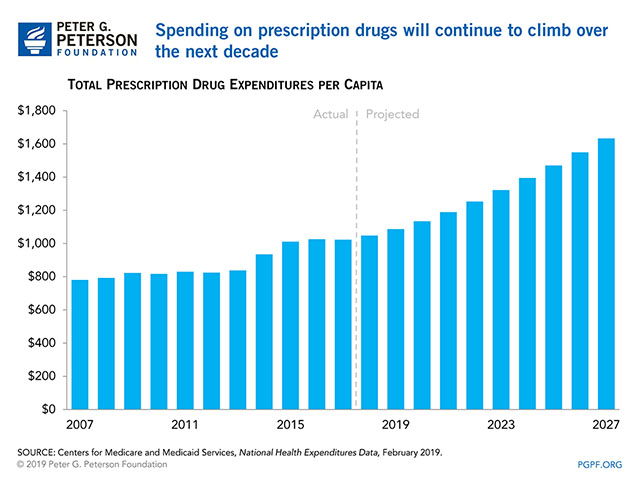
Since 1960, the average amount of money that each person spends on prescription drugs in the US has skyrocketed by more than 1,000% when accounting for inflation. Compared to other wealthy countries, the cost of medicines in the US is almost three times higher, a fact that should stir a sense of injustice in all of us. The graph below shows the growing cost of prescriptions since 2007.
Did you know that bringing a new drug to the market costs a lot of money? The process involves paying for patent delays, paying other companies to delay releasing generic brands, the cost of marketing,as well as the cost of research and development. Companies usually set the drug prices to make back the money they spent and make a profit. But here’s the thing – most new drugs never even make it to the market. This means that the cost of the failed drugs adds to the price of the ones that do make it.
This is a big deal because drug prices have gone up significantly in the past ten years. It’s becoming harder for many people to afford the medicine they need. In fact, a 2015 survey showed that about 20% of Americans didn’t get their prescription medicine because they were worried about the cost.
It doesn’t seem right that a wealthy country like the United States gives the oil industry billions of dollars in tax credits. Instead of doing that, we could take some of that money and use it to make life-saving drugs more affordable for people in the US.
Citations
Medicare announces lower prices
Biden’s latest Medicare pharmaceutical price cuts
What are the recent and forecasted trends in prescription drug spending?
Discover more from Random Thoughts
Subscribe to get the latest posts sent to your email.
 Random Thoughts
Thankfully here in Europe prescription drugs are covered by our national health system (social security) and we pay very little. For other medications not prescribed, there are fixed prices which are substantially less than in the states. Too bad there is not a national health act in the US, it would alleviate the suffering of many, after all health care is for everyone and should not be a political ploy. Cheers.
LikeLiked by 1 person
Unfortunately, corporations rule us, and they wield too much power over our politicians.
LikeLiked by 1 person
So true, lamentably.
LikeLike